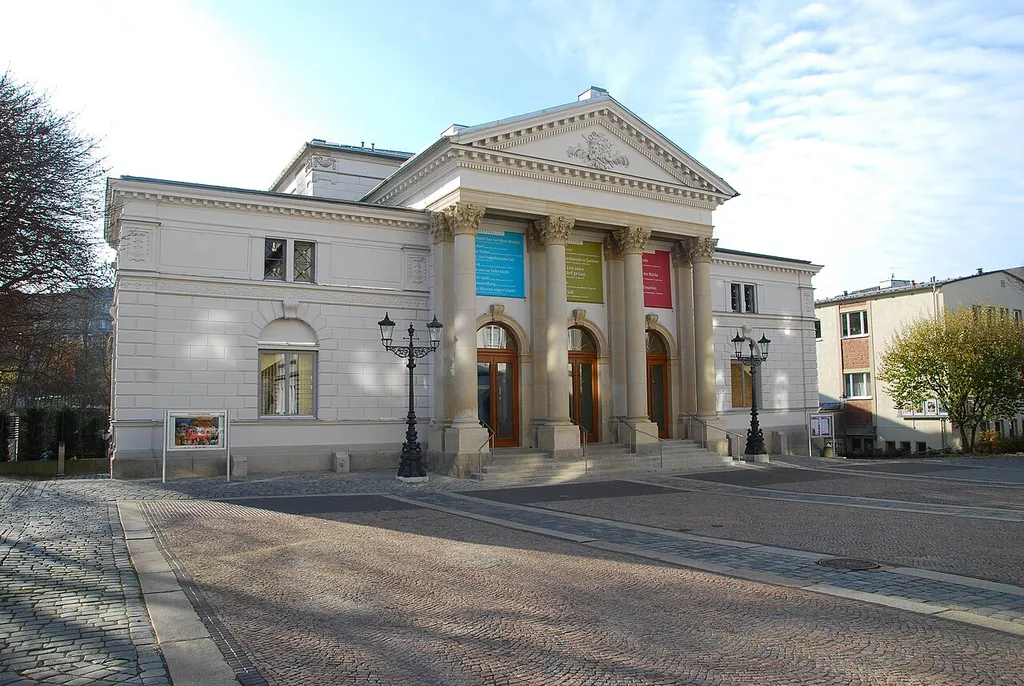
Plauen is worth a stop: 10 minutes from Neuensalz, 56km from Loket Castle.
Plauen is in Saxony, Germany, with about 66,000 people. You drive on the right here. The nearest town is Neuensalz, about 6 km away.
Plauen (German pronunciation: [ˈplaʊən] PLOW-en; Upper Sorbian: Pławno; Czech: Plavno) is a town in Saxony, Germany with a population of around 65,000. It is Saxony's 5th most populated city after Leipzig, Dresden, Chemnitz and Zwickau, the second-largest city of the Vogtland after Gera, as well as the largest city inRead more the Saxon Vogtland region (Sächsisches Vogtland).
The city lies on the upper reaches of the White Elster River, a tributary of the Saale, in the Central Vogtlandian Hill Country. Plauen is the southwesternmost city of a string of cities sitting in the densely populated foreland of the Elster and Ore Mountains, stretching from Plauen in the southwest via Zwickau, Chemnitz and Freiberg to Dresden in the northeast. It is the county seat of the Vogtland District. Plauen directly borders Greiz in Thuringia to the north, and it is also situated near the Saxon border with Bavaria (Franconia) and the Czech Republic (Bohemia).
Plauen and the surrounding Saxon Vogtland are known as the historic center of the German embroidery and lace industry, and the products of the region are protected under the label Plauener Spitze ("Plauen Lace"). The Elster Viaduct (Elstertalbrücke), spanning the valley of the White Elster between Plauen and Pöhl, is the second-largest bridge built out of bricks in the world, after the Göltzsch Viaduct.
Despite its location in Saxony the regional Vogtlandian dialect spoken in Plauen is a variety of East Franconian (with Saxon influences) related to the dialects of neighbouring Franconia in Bavaria. The name of the city as well as the names of many of its neighborhoods and boroughs are of Slavic origin.
Germany's oldest road racing circuit, in use since 1923, a triangle of Thuringian public roads still raced on today. The public sections make an atmospheric drive with the racing surface underfoot.
23 km · about 25 min drive
museum
August Horch Museum
Museum in the birthplace of Audi tracing Saxon automobile history from Horch and DKW through Trabant and modern Volkswagen.
36 km · about 40 min drive
racetrack
Sachsenring
A uniquely anti-clockwise circuit in Saxony with dramatic elevation changes, famous as a left-turn-dominant MotoGP venue.
51 km · about 60 min drive
castle
Loket Castle
A stout Romanesque-Gothic castle on a rocky spur encircled by the Ohre river, near Karlovy Vary.
56 km · about 65 min drive
landmark
Karlovy Vary
An elegant spa town famous for its hot springs, ornate colonnades, and pastel-colored buildings nestled in a forested valley.
60 km · about 70 min drive
Driving roads near Plauen
23 kmSchleizer DreieckGermany's oldest road racing circuit, in use since 1923, a triangle of Thuringian public roads still raced on today. The public sections make an atmospheric drive with the racing surface underfoot.