Switzerland is a country built for driving. Snow-capped peaks, pristine lakes, and hairpin mountain passes create some of the most breathtaking road trips in Europe. But Swiss roads come with a unique set of rules and requirements that catch many visitors off guard. From the mandatory motorway vignette to strict winter tyre regulations, understanding the system before you go will save you money, stress, and potentially a hefty fine.
This guide covers everything you need to know about driving in Switzerland, whether you are crossing through on a European road trip or spending a week exploring the Alps.
The Swiss Motorway Vignette
The single most important thing to know before driving on a Swiss motorway is the vignette requirement. Every vehicle using Switzerland's national roads (Autobahnen and Autostrassen) must display a valid vignette sticker on the windscreen. There is no pay-per-use toll system; instead, you pay a flat annual fee.
Key Vignette Facts
- Cost: CHF 40 (approximately EUR 42) for a calendar-year vignette, valid from 1 December of the preceding year to 31 January of the following year.
- Where to buy: At border crossings, Swiss post offices, petrol stations near the border, and online through the Swiss Federal Customs Administration. You can also buy them at ADAC offices in Germany and ACI offices in Italy before crossing.
- E-vignette: Since August 2023, Switzerland also offers a digital e-vignette linked to your licence plate. You can purchase it online and skip the sticker entirely.
- Penalties: Driving on a motorway without a valid vignette carries a fine of CHF 200, plus you will be required to purchase one on the spot.
- Placement: The physical sticker must be affixed directly to the windscreen (not on a removable holder). Removing and reattaching it invalidates the vignette.
If you are only passing through Switzerland briefly and want to avoid the vignette cost, you can legally use cantonal roads (marked in blue) instead of motorways (marked in green). However, this will significantly increase your journey time.
Mountain Passes: Seasons, Closures & Driving Tips
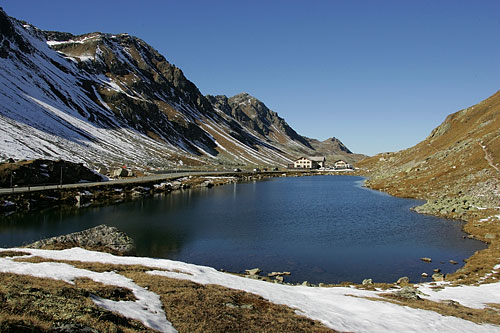
Switzerland has over 30 major mountain passes, and they form the backbone of the country's most spectacular driving routes. However, many passes close entirely during winter, and conditions can change rapidly even in summer.
Major Passes and Typical Opening Periods
- Gotthard Pass (2,106 m): Usually open June to October. The Gotthard Tunnel is open year-round as an alternative.
- Furka Pass (2,429 m): Usually open June to October. Famous from the James Bond film Goldfinger.
- Grimsel Pass (2,164 m): Usually open June to October. Connects the Bernese Oberland to the Valais.
- Susten Pass (2,224 m): Usually open June to October. Widely regarded as the most beautiful pass in Switzerland.
- Julier Pass (2,284 m): Open year-round (one of the few high passes that is). Connects the Engadin to the Rhine valley.
- Great St Bernard Pass (2,469 m): Usually open June to October. The tunnel beneath it is open year-round (toll: approximately CHF 28 one-way for cars).
Check the real-time status of all Swiss mountain passes at the Touring Club Switzerland (TCS) website before setting out. Passes can close with little warning due to snowfall, even in late spring or early autumn.
Driving Technique on Passes
Swiss mountain passes feature tight hairpin bends, steep gradients (often 10-12%), and single-lane sections. Follow these rules:
- Ascending traffic has priority over descending traffic on narrow sections.
- PostBus vehicles (the iconic yellow postal buses) always have right of way. When you hear their distinctive three-tone horn, pull over immediately.
- Use a low gear when descending to save your brakes. Engine braking is expected and encouraged.
- Never cross the centre line on blind bends, even if the road appears empty.
Winter Driving Rules
Swiss winters are serious, and the law reflects that. While Switzerland does not legally mandate winter tyres the way Germany does, the practical reality is that you need them.
Tyres and Chains
- Winter tyres: Not legally compulsory nationwide, but if you cause an accident or obstruction with summer tyres in winter conditions, you can be held liable and fined. Most rental companies fit winter tyres from November to March.
- Snow chains: Required on certain roads and passes, indicated by a blue circular sign with a chain symbol. Carry chains if you plan to drive in mountainous areas between October and May.
- Studded tyres: Permitted from November to April but banned on motorways and semi-motorways. Maximum speed with studded tyres is 80 km/h.
Other Winter Rules
- You must clear all snow and ice from your vehicle (roof, bonnet, lights, windows) before driving. The fine for not doing so can reach CHF 150.
- Dipped headlights are recommended at all times and mandatory in tunnels. Switzerland does not require daytime running lights by law, but most modern cars have them.
- Car trains through tunnels (such as the Lotschberg and Vereina tunnels) operate year-round and are an excellent alternative to closed passes. You drive your car onto a flatbed rail carriage and ride through the mountain.
Speed Limits, Fines & the Parking Disc System
Speed Limits
- Urban areas: 50 km/h (30 km/h in many residential zones)
- Outside urban areas: 80 km/h
- Semi-motorways: 100 km/h
- Motorways: 120 km/h
Switzerland enforces speed limits with exceptional rigour. Fixed and mobile speed cameras are widespread, and fines escalate steeply. Exceeding the limit by 1-5 km/h in an urban area costs CHF 40, but exceeding it by 25 km/h or more on a motorway can result in a fine of several hundred francs, licence confiscation, and even criminal prosecution for extreme cases (the "Via Sicura" law).
Swiss speed cameras often have no warning signs. Do not rely on GPS-based camera alerts either, as using radar detector apps is illegal in Switzerland and carries a fine of up to CHF 10,000.
The Blue Zone Parking Disc
Many Swiss towns use a blue zone parking system. In areas marked with blue road paint and a blue zone sign, you must display a parking disc (Parkscheibe) on your dashboard showing your arrival time. Parking is then free for a limited period, usually 60 or 90 minutes.
- You can get a free parking disc at police stations, tourist offices, and some petrol stations.
- Set the disc to the next half-hour after your arrival (e.g., if you arrive at 10:10, set it to 10:30).
- Overstaying the time limit typically results in a fine of CHF 40.
Scenic Routes Worth Driving
Switzerland's official "Grand Tour" is an epic 1,600 km route that connects the country's highlights. But you do not need to commit to the full loop to enjoy world-class scenery.
Top Driving Routes
- The Three Passes (Susten, Grimsel, Furka): A 120 km loop from Meiringen through three legendary Alpine passes. Allow a full day and start early to avoid traffic.
- Lakeshore Drive, Lake Geneva: Follow the northern shore from Geneva through the Lavaux vineyards (a UNESCO World Heritage Site) to Montreux. Gentle, scenic, and perfect for a half-day drive.
- Bernina Pass to Tirano: Cross from the Engadin into Italy via the 2,328-metre Bernina Pass. The descent into the Poschiavo valley is extraordinary.
- Klausen Pass: A quieter alternative to the famous passes, connecting Altdorf to Linthal with stunning views of the Glarner Alps.
Ready to map out your Swiss route? Plan this trip and explore Interlaken as a base for mountain pass driving.
Practical Tips for Driving in Switzerland
- Fuel: Petrol is expensive (roughly CHF 1.80-2.00 per litre). Diesel is slightly cheaper. Many stations are unmanned and accept cards only.
- Right of way: On equal-priority roads, traffic from the right has priority. This rule applies even in roundabouts unless otherwise signed.
- Headlights in tunnels: Mandatory, even in well-lit tunnels. Switch on dipped headlights before entering.
- Alcohol limit: 0.05% BAC (0.01% for new drivers with fewer than 3 years of experience).
- Emergency equipment: A warning triangle is compulsory. A high-visibility vest and first-aid kit are strongly recommended.
- Motorway rest stops: Generally excellent, with clean facilities, but food and drink prices are high. Stock up at a supermarket before your journey.
Frequently Asked Questions
Do I need a vignette if I am just passing through Switzerland on the motorway?
Yes. Any vehicle using a Swiss motorway or semi-motorway must have a valid vignette, even for a short transit. The only way to avoid it is to use cantonal (non-motorway) roads, which is legal but much slower. Since 2023, you can buy a digital e-vignette online linked to your licence plate, which is convenient for one-time transits.
Can I drive in Switzerland with my regular driving licence?
EU and EEA driving licences are valid in Switzerland without additional documentation. UK licence holders can also drive for up to 12 months. If your licence is not in German, French, Italian, or English, you should carry an International Driving Permit (IDP) alongside your national licence. Non-European visitors generally need an IDP.
Are Swiss mountain passes safe for inexperienced drivers?
Most major passes are well-maintained with good road surfaces and barriers. However, they require confidence with steep gradients, tight hairpins, and exposure to heights. If you are uncomfortable, consider using the car-train tunnels (Lotschberg, Vereina) as alternatives. Start with gentler passes like the Julier or Bruenig before tackling the Furka or Gotthard.